Ashwagandha: who should and shouldn't take it (2026)

In April 2023, Denmark announced a ban on ashwagandha in food supplements. Its risk assessors had concluded that the available data did not allow them to set a safe intake. The Netherlands said in April 2026 that it intends to do the same. In the UK, the Food Standards Agency asked for evidence in the summer of 2024, and its expert advisers on the Committee on Toxicity discussed a third draft statement on 8 September 2026. That statement has not been published yet.
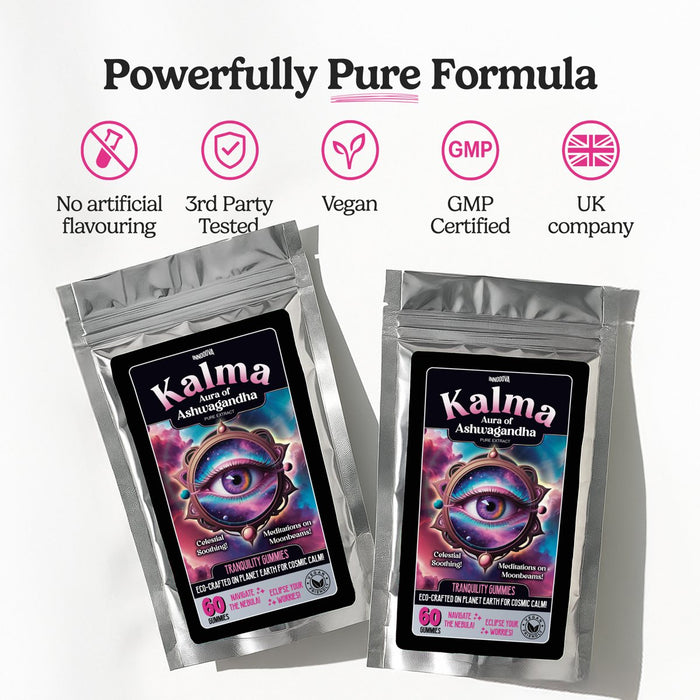
We sell an ashwagandha gummy, Kalma, so read this page knowing that. We have tried to write it as plainly as we would for our own families. For what ashwagandha is and how it has traditionally been used, see our full ashwagandha guide.
Last reviewed 26 September 2026. This page is general information and does not replace advice from your GP or pharmacist.
Who should not take ashwagandha
Skip it, or speak to your GP or pharmacist first, if any of these apply to you.
- You are pregnant, trying to get pregnant or breastfeeding. There is no reliable human safety data, and some traditional texts describe ashwagandha as able to bring on a miscarriage.
- You have a thyroid condition, especially an overactive thyroid, or you take thyroid medication such as levothyroxine.
- You have liver disease now, have had liver problems in the past, or drink heavily.
- You have an autoimmune condition such as rheumatoid arthritis, lupus, multiple sclerosis, Hashimoto's thyroiditis or type 1 diabetes.
- You take medicine for diabetes, blood pressure, anxiety, sleep or epilepsy, or to suppress the immune system, for example after a transplant.
- You have surgery coming up. Stop at least two weeks before, because ashwagandha may add to the effects of anaesthetic and sedative medicines.
- You are under 18. The trials have been in adults.
- You have reacted badly to ashwagandha before. It belongs to the nightshade family, alongside tomatoes, potatoes and peppers, so mention any nightshade allergy to your pharmacist.
The common side effects
Most people in clinical trials of ashwagandha root extract reported nothing unusual. When complaints did come up, they were usually mild and went away after stopping. The ones seen most often are:
- an upset stomach, loose stools or diarrhoea
- nausea
- drowsiness
- headache
Longer safety lists add dizziness, a blocked nose, dry mouth, reduced appetite, constipation, acid reflux, skin rash, blurred vision, night cramps and weight gain. Many of those come from single reports.
The largest pooled look at safety so far is a 2026 systematic review by Coope and colleagues. It gathered 23 randomised trials of standardised root extract in healthy adults, 2,317 people in total, taking 125 to 600 mg a day for up to 180 days. Liver, kidney, blood, hormone and heart markers stayed within normal ranges, and mild complaints turned up in both the ashwagandha and comparison groups. Two of the authors have done paid work for supplement companies, which the paper declares.
Plenty of people say they feel calmer on it. A smaller number say the opposite: wired, restless or more on edge. If you feel worse after starting, stop. Severe allergic reactions are rare, but swelling of the face or throat, wheezing or trouble breathing needs a 999 call.
Ashwagandha and your liver
Liver injury is the most serious side effect linked to ashwagandha. It is rare, and it is also the main reason regulators are looking at it again.
- Iceland and the US, 2020. Björnsson and colleagues described five people aged 21 to 62 who developed jaundice between 2 and 12 weeks after starting an ashwagandha supplement. Itching and raised bilirubin lasted 5 to 20 weeks. Nobody developed liver failure, and liver tests returned to normal within one to five months in the four people who were followed up. Testing found no other toxic compounds in the products.
- India, 2023. Philips and colleagues found 23 people with liver injury linked to ashwagandha between 2019 and 2022, and reported on the eight who had taken single-ingredient products. Five of the eight already had chronic liver disease. Three of them developed acute-on-chronic liver failure and died.
- Bosnia and Herzegovina, 2023. Bokan and colleagues described two more cases, including a 36-year-old man who had taken 450 mg three times a day for six months. Both improved after stopping. Their review of earlier reports includes one case that ended in a liver transplant.
The damage in these reports was mostly cholestatic, meaning the flow of bile was affected, hence the jaundice and itching. Most people recovered after stopping, sometimes slowly. People who already had liver disease did far worse.
The Committee on Toxicity discussed a paper on herb-induced liver injury on 14 July 2026. It cites the Iceland and US cases and notes that the FSA received a rising number of incidents involving ashwagandha supplements between February 2021 and December 2024. That rise is why the FSA asked the committee to review ashwagandha in the first place.
Stop taking it and contact your GP or NHS 111 the same day if you notice any of these:
- yellowing of the skin or the whites of the eyes
- dark urine or pale stools
- itching all over without a rash
- pain in the upper right side of your tummy, nausea or loss of appetite
- unusual tiredness or weakness
Ashwagandha and your thyroid
Ashwagandha appears to push thyroid hormone levels up in some people. If you have an overactive thyroid, or you are on a carefully balanced dose of levothyroxine, that nudge goes in the wrong direction.
- Sharma and colleagues, 2018. Fifty adults with subclinical hypothyroidism, meaning a raised TSH without obvious symptoms, took 600 mg of root extract or a placebo for eight weeks. T3 and T4 rose and TSH fell in the ashwagandha group compared with placebo.
- Gannon and colleagues, 2014. In an eight-week trial in people with bipolar disorder, the three ashwagandha users who had abnormal thyroid readings all saw T4 rise, by between 7% and 24%. The numbers are tiny.
- Case reports. A healthy 32-year-old woman in the Netherlands developed thyrotoxicosis after increasing her dose (van der Hooft, 2005). A 73-year-old woman in the US developed a fast heart rhythm after two years of using ashwagandha to self-treat an underactive thyroid (Kamal, 2022). A 47-year-old man in Japan developed painless thyroiditis two months after starting it (Hayashi, 2024). All three got better after stopping.
If you take thyroid medication, or your thyroid runs high, talk to your GP first. If you already take ashwagandha and notice palpitations, shakiness, feeling hot all the time or unexplained weight loss, stop and ask for a thyroid blood test.
Pregnancy, breastfeeding and hormones
Nobody has run a proper safety study of ashwagandha in pregnancy. Some classical Ayurvedic texts describe it as able to cause a miscarriage, while other readings treat it as a tonic, and regulators have taken the cautious view. Australia's Therapeutic Goods Administration requires a pregnancy warning on ashwagandha products, and France's food safety agency, ANSES, has advised pregnant and breastfeeding women to avoid it. It is not known whether it passes into breast milk.
It also seems to affect sex hormones. Several trials in men recorded rises in testosterone, all within the normal range, and an older review linked it with changes in sperm quality after two to four months. The Danish risk assessment in 2020 raised concerns about reproductive hormones, based largely on animal studies. If you are trying to conceive, it is sensible to leave it out and talk to your GP or midwife about any supplements you take.
Medicines that may interact with ashwagandha
Most of what is known here comes from how ashwagandha seems to act in the body and from lab studies, with only a few confirmed cases in people. Treat the table as a list of things to ask about.
| Medicine | Why it matters |
|---|---|
| Levothyroxine and other thyroid medicines | Ashwagandha may raise thyroid hormone further, tipping a stable dose too high |
| Tablets or insulin for diabetes | Some small trials recorded lower blood sugar, so levels could drop too far |
| Blood pressure medicines | It may add to their effect and lower blood pressure further |
| Benzodiazepines, sleeping tablets, barbiturates and epilepsy medicines | Extra drowsiness. Ashwagandha appears to act on GABA, the same calming signal many of these medicines use |
| Immunosuppressants, including after a transplant | It may stimulate parts of the immune system. There is a published case of kidney transplant rejection |
| Medicines cleared by the CYP3A4 or CYP2B6 liver enzymes | In lab tests it slowed one of these enzymes and sped up the other. Not confirmed in people |
| Digoxin | It can give a falsely high reading on some digoxin blood tests |
| Alcohol | Adds to drowsiness |
If you take any regular medicine, a pharmacist can check it against ashwagandha in a couple of minutes. Take the pack with you.
Autoimmune conditions and surgery
In lab and animal work, ashwagandha has stimulated parts of the immune system. In an autoimmune condition, where the immune system is already attacking the body, that is the last thing you want. The evidence in people is thin, so this is caution rather than proof of harm.
Before an operation, stop taking it at least two weeks ahead. Ashwagandha may add to the sedating effect of anaesthetic and pain relief, and it may affect blood sugar and blood pressure around the time of surgery. Tell the surgical team about every supplement you take. Gummies count.
Is ashwagandha safe? What the evidence shows and where it runs out
What the trials and case reports show:
- In healthy adults, standardised root extracts at 125 to 600 mg a day for up to six months produced few, mostly mild, side effects in trials.
- Rare but serious liver injury and thyroid problems have been reported in individuals, usually weeks to months after starting.
- People with existing liver disease appear to be at much greater risk if liver injury does occur.
What it does not show:
- Safety beyond about six months. Very few trials run longer.
- Safety in pregnancy, breastfeeding or children, or in older adults with several health conditions.
- How often liver injury happens. Case reports cannot give a rate, and trials of a few hundred people are too small to catch something this rare.
- Whether leaf extracts behave like root. Most trials used root, while some products use leaf. India announced a ban on ashwagandha leaf in food products in April 2026, which its courts have since put on hold.
- A safe upper limit. Danish assessors concluded in 2020 that one could not be set from the data, and that is the core of their ban.
Product quality adds another layer. Plant material varies with growing conditions and processing, and lead contamination has been reported in some Ayurvedic preparations.
How long can you take it for?
Most trials ran for 8 to 12 weeks, at 125 to 600 mg of extract a day. Harvard Health describes ashwagandha as well tolerated for up to three months in healthy people and suggests talking to a doctor before going further. The Coope review found trials up to 180 days with no worrying blood results, and very little data beyond that.
Some people take a break after two or three months. If you miss a dose, don't double up the next day, and don't combine several products that each contain ashwagandha. Sleep and stress blends often include it.
Where the UK review is up to
- 8 July to 1 September 2024. The FSA ran a call for evidence on the safety of ashwagandha in food and food supplements.
- 25 June 2026. It published a summary of the 19 responses: 8 from food businesses, 7 from industry representatives, 3 from members of the public and 1 from a university research team.
- 14 July 2026. The Committee on Toxicity discussed herb-induced liver injury, including the ashwagandha cases.
- 8 September 2026. The committee discussed its third draft statement on ashwagandha. The paper is being prepared for publication.
Once the statement is final it will be published, and all four UK nations will then consider it before any rule changes. Until that happens there is no official UK advice telling people to stop taking ashwagandha, and there are no UK limits on how much a product can contain. The NHS website does not have a page on ashwagandha.
What the committee will conclude is the open question, and we do not know the answer. It could set a maximum daily amount, ask for warnings, or recommend something stronger. We will update this page when the statement is out.
Ashwagandha also has no authorised health claim on the Great Britain nutrition and health claims register, unlike vitamins such as B6, so pack promises about stress or sleep deserve a sceptical read.
Denmark and the rest of Europe
- Denmark announced its ban in April 2023, after a 2020 risk assessment by the Technical University of Denmark raised concerns about sex hormones, the thyroid, the immune system and pregnancy.
- The Netherlands health ministry said in April 2026 that it intends to ban ashwagandha in supplements. We have not seen a start date.
- Sweden has taken some high-strength products off the market.
- France, through ANSES, has advised pregnant and breastfeeding women, under 18s and people with thyroid, liver or heart conditions to avoid it.
- Poland set upper daily limits rather than banning it.
- At EU level, the heads of national food safety agencies recommended in 2024 a formal procedure that could restrict ashwagandha across the EU. It has not concluded.
Supplement makers argue the Danish assessment leaned on animal data and non-root products. An EU decision would not apply in Great Britain, though Northern Ireland follows EU food rules in many areas.
Choosing a product if you decide to take it
- Root extract. Check the label says root, not leaf or whole plant.
- A stated withanolide percentage, which tells you the extract has been standardised.
- A UK address for the business responsible and a batch number on the pack.
- Warnings on the label covering pregnancy, medication, and liver and thyroid conditions.
- One ashwagandha product at a time.
Harvard Health points US readers to testing seals such as USP and NSF. UK packs rarely carry these, so ask the seller for a certificate of analysis for your batch.
What the human trials found
Ashwagandha is one of the most studied herbal supplements, with dozens of placebo-controlled trials. Three give a feel for the research on stress and sleep.
| Study | Who took part | What they took | What they found |
|---|---|---|---|
| Chandrasekhar et al., Indian Journal of Psychological Medicine, 2012 | 64 adults with a history of chronic stress | 300 mg root extract twice a day for 60 days | Lower scores on stress questionnaires than the placebo group. Blood cortisol fell by 27.9% |
| Langade et al., Cureus, 2019 | 60 adults with insomnia | 300 mg root extract twice a day for 10 weeks | Fell asleep faster and rated their sleep quality higher than the placebo group |
| Cheah et al., PLOS One, 2021 | Five trials pooled, 400 adults | Various root extracts | A small but significant effect on overall sleep, stronger at 600 mg a day or more and over eight weeks or more |
None of these reported serious side effects. They were also small and short, so rare problems like liver injury would not show up in them. For more on the trials, see our ashwagandha guide and research page.
How Kalma fits in
Kalma contains ashwagandha root extract, concentrated 10:1 and standardised to 5% withanolides, plus vitamin B6. It is vegan, made with pectin, and a pack holds 60 gummies. The trials on this page did not test it. Each used its own extract at its own amount.
Vitamin B6 is where a health claim can be made. It contributes to normal psychological function and to the reduction of tiredness and fatigue, and both claims are authorised in Great Britain. We make no health claims for the ashwagandha itself.
The Kalma pack and product page carry the warnings on this page. We think ashwagandha is reasonable for most healthy adults outside the groups listed above, taken at normal amounts for a few months at a time. We also think the regulators are right to look hard at it. If the Committee on Toxicity's assessment changes what is safe to sell, we will change the formula.
If you think you are having a side effect
- Stop taking it.
- For yellowing skin or eyes, dark urine or pale stools, contact your GP or NHS 111 the same day. For swelling of the face or throat or trouble breathing, call 999.
- Keep the pack so you have the batch number.
- Report it through the MHRA Yellow Card scheme.
Not sure ashwagandha is right for you at all? Your pharmacist is a good first stop, and you do not need an appointment.
FAQs
What are the most common side effects of ashwagandha?
The side effects reported most often in trials are an upset stomach, loose stools or diarrhoea, nausea, drowsiness and headache. They are usually mild and tend to settle once you stop. In a 2026 review of 23 trials in healthy adults, these complaints turned up in both the ashwagandha and comparison groups, so not all of them were caused by the extract. Rarer and more serious problems, including liver injury and thyroid changes, come mainly from individual case reports.
Is ashwagandha bad for your liver?
Liver blood tests stayed normal across 23 trials in healthy adults, so problems are uncommon. There are, however, published cases of liver injury, usually starting 2 to 12 weeks after someone began taking it, with jaundice and itching. Most people recovered within a few months of stopping. In an Indian case series, three people who already had chronic liver disease died of liver failure, so avoid ashwagandha completely if you have liver problems.
Why shouldn't you take ashwagandha every day?
Taking it daily is how it was used in the trials, so daily use on its own is not the worry. The gap is duration. Most studies lasted 8 to 12 weeks and very few went past six months, which means there is little evidence about taking it for years. Harvard Health suggests talking to a doctor before going beyond three months, and some people take a break every couple of months.
Why don't doctors recommend ashwagandha?
Many doctors are cautious because supplements are not tested like medicines, product strength varies, and the long-term evidence is thin. Doctors also see the rare cases trials miss, such as liver injury and thyroid problems, and know it may interact with thyroid, diabetes and sedative medicines. Some are comfortable with short-term use in healthy adults. If you want a view on your own situation, take the pack to your GP or pharmacist.
What should you never mix with ashwagandha?
Avoid mixing it with alcohol, sleeping tablets, benzodiazepines, barbiturates or epilepsy medicines, because the drowsiness can add up. Do not combine it with thyroid medicines, immunosuppressants, or diabetes and blood pressure medicines without advice from your GP or pharmacist. Also avoid doubling up on ashwagandha itself, since it often appears in sleep and stress blends alongside other ingredients. A pharmacist can check your medicines against it quickly.
Is ashwagandha banned in the UK?
No. As of 26 September 2026 ashwagandha is legal to sell in UK food supplements, and there is no limit on how much a product can contain. The Food Standards Agency is reviewing its safety, and the Committee on Toxicity discussed a third draft statement on 8 September 2026. Its findings will be published and then considered by all four UK nations before any rules change.
Why did Denmark ban ashwagandha?
Denmark's food authority acted on a 2020 risk assessment from the Technical University of Denmark. The assessors concluded that a safe intake level could not be set from the available data, and raised concerns about sex hormones, the thyroid, the immune system and pregnancy. Much of that evidence came from animal studies, and supplement makers have disputed it. The ban was announced in April 2023, and the Netherlands said in April 2026 that it intends to follow.
Can ashwagandha affect your thyroid?
Yes, in some people. In a 2018 trial of 50 adults with subclinical hypothyroidism, 600 mg a day for eight weeks raised T3 and T4 compared with placebo. Case reports from the Netherlands, the US and Japan describe thyrotoxicosis, an excess of thyroid hormone, in people taking it, which cleared up after they stopped. Avoid it if you have an overactive thyroid, and talk to your GP first if you take levothyroxine.
Can I take ashwagandha while pregnant or breastfeeding?
No. There are no good human safety studies in pregnancy, some traditional texts describe it as able to cause a miscarriage, and nobody knows whether it passes into breast milk. Australia requires a pregnancy warning on ashwagandha products and France advises pregnant and breastfeeding women to avoid it. If you are trying to conceive, it makes sense to leave it out and talk to your GP or midwife about any supplements you take.
How quickly do ashwagandha side effects appear?
Stomach upset and drowsiness, when they happen, tend to appear soon after starting. Liver injury in the published cases appeared later, typically 2 to 12 weeks after starting, and in one case after six months. Thyroid problems have been reported anywhere from a few weeks to two years in. That spread is why it is worth knowing the warning signs for as long as you take it, and not only in the first week.
Sources
- Summary of responses to call for evidence on ashwagandha, Food Standards Agency, 25 June 2026
- 8 September 2026 Committee on Toxicity meeting, GOV.UK
- Herb induced liver injury, Committee on Toxicity meeting 14 July 2026, GOV.UK
- Why did Denmark ban ashwagandha?, McGill Office for Science and Society
- Björnsson et al., Liver International, 2020
- Philips et al., Hepatology Communications, 2023
- Bokan et al., Pharmaceuticals, 2023
- Coope et al., Pharmaceuticals, 2026
- Sharma et al., Journal of Alternative and Complementary Medicine, 2018
- Gannon et al., Journal of Ayurveda and Integrative Medicine, 2014
- van der Hooft et al., Nederlands Tijdschrift voor Geneeskunde, 2005
- Kamal et al., Cureus, 2022
- Hayashi et al., Cureus, 2024
- Chandrasekhar et al., Indian Journal of Psychological Medicine, 2012
- Langade et al., Cureus, 2019
- Cheah et al., PLOS One, 2021
- Great Britain nutrition and health claims register, GOV.UK
- The Yellow Card scheme, MHRA